
Explore Delta Lake

Explore Delta Lake:

Delta Lake is an open-source data storage layer that runs on top of existing data lake systems, such as Apache Hadoop or Amazon S3. It was developed by Databricks, a company that provides a unified analytics platform for data engineering, data science, and machine learning.

Delta Lake provides ACID transactions, schema enforcement, and other data management features on top of data lakes, which are typically used for storing large volumes of unstructured and semi-structured data. By adding these features, Delta Lake makes data lakes more suitable for use cases where data quality, consistency, and reliability are important, such as data science, machine learning, and analytics.

Some of the key features of Delta Lake include:

ACID Transactions: Delta Lake provides transactional guarantees for both batch and streaming data. This means that data operations, such as inserts, updates, and deletes, are executed in an atomic, consistent, isolated, and durable (ACID) manner. ACID transactions ensure data integrity and consistency, even in the face of concurrent updates or failures.

Schema Enforcement: Delta Lake provides schema enforcement, which ensures that data adheres to a predefined schema. This feature allows for easier data validation, data quality checks, and data governance. Additionally, Delta Lake allows for schema evolution, meaning that the schema can be changed over time without disrupting existing data.
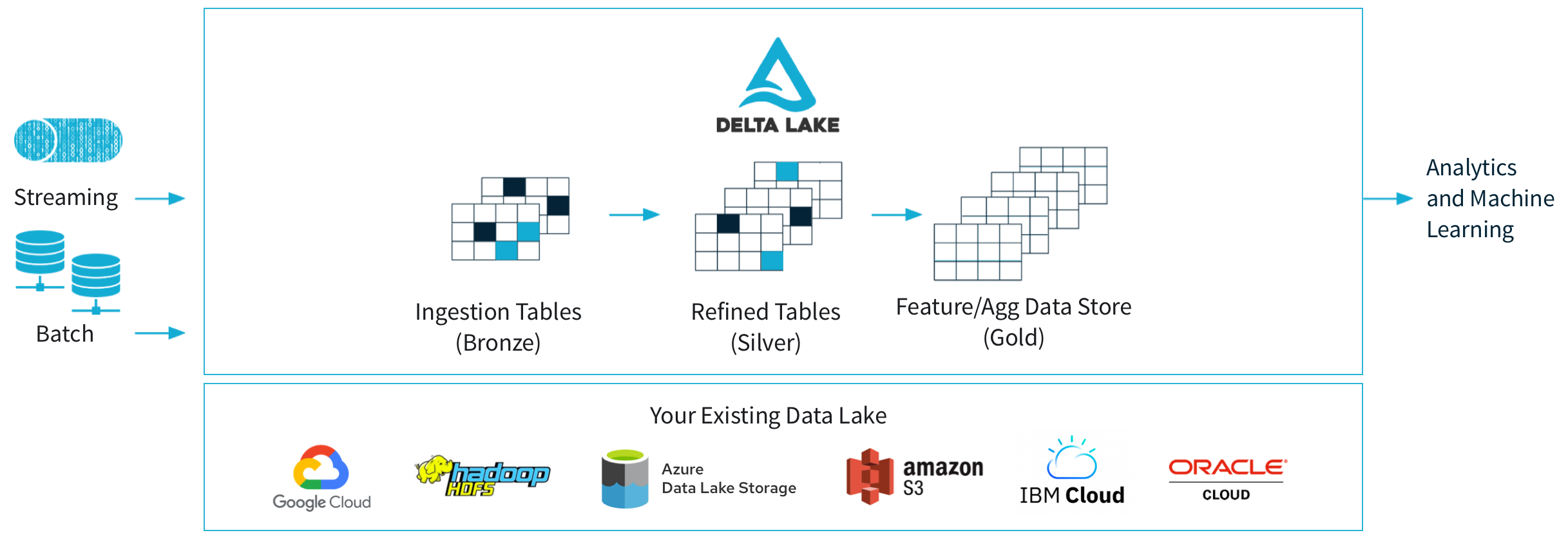


Ref.: https://delta.io/static/delta-hp-hero-bottom-46084c40468376aaecdedc066291e2d8.png

Time Travel: Delta Lake provides time travel, which allows for versioning and historical querying of data. This feature enables data analysts and data scientists to query data at different points in time, enabling them to track changes and understand trends over time.

Unified Batch and Streaming: Delta Lake supports both batch and streaming workloads, allowing for real-time data processing and analytics. This feature makes it easier to build end-to-end data pipelines that can handle both batch and streaming data, without requiring separate data storage or processing systems.

Open Source: Delta Lake is an open-source project, meaning that it is freely available to use and contribute to. This allows organizations to customize and extend Delta Lake to meet their specific needs and use cases.

Overall, Delta Lake provides a more reliable and consistent data storage layer on top of data lakes, making it easier for organizations to manage and analyze their data effectively. It has become a popular choice for data science and analytics workloads, particularly for organizations that use the Apache Spark processing engine.

Comments

Popular posts from this blog

MySQL InnoDB cluster troubleshooting | commands

Cluster Validation: select * from performance_schema.replication_group_members; All members should be online. select instance_name, mysql_server_uuid, addresses from  mysql_innodb_cluster_metadata.instances; All instances should return same value for mysql_server_uuid SELECT @@GTID_EXECUTED; All nodes should return same value Frequently use commands: mysql> SET SQL_LOG_BIN = 0;  mysql> stop group_replication; mysql> set global super_read_only=0; mysql> drop database mysql_innodb_cluster_metadata; mysql> RESET MASTER; mysql> RESET SLAVE ALL; JS > var cluster = dba.getCluster() JS > var cluster = dba.getCluster("<Cluster_name>") JS > var cluster = dba.createCluster('name') JS > cluster.removeInstance('root@<IP_Address>:<Port_No>',{force: true}) JS > cluster.addInstance('root@<IP add>,:<port>') JS > cluster.addInstance('root@ <IP add>,:<port> ') JS > dba.getC...

Amazon RDS | Amzon Redshift | Big Data | Boost Performance with Amazon ElastiCache

Amazon RDS with Amazon ElastiCache for Performance: Amazon RDS supports - Oracle, MS SQL server, MySQL, Maria DB and PostgreSQL. It is a managed service offered by the Amazon.  Couple of customers have observed the performance issues during their journey with Amazon RDS with Oracle, MS SQL Server, MySQL, Maria DB and PostgreSQL. Amazon cloud engineers / database consultants / database architect and Amazon supports worked to-gather to boost the Amazon RDS performance by tuning the RDBMS configuration parameters using Amazon RDS parameter group , and have not achieved the SLA for Amazon RDS .  Amazon RDS with Multi AZ and Read Replica: Some of the the AWS professionals have suggested for vertical scaling of the Amazon RDS . It should works and its absolutely correct. In my opinion, it would be a good idea to think about the Amazon ElastiCache service with Amazon RDS for better performance and cost optimization also rather than vertically scaling the Amazon RDS . I would sug...

Needs for Graph Database

Needs for Graph Database: We are living in the era of data, data is treated more precise than gold and platinum. Most of the enterprises are trying to get more insight about the data they have it as an operational / warehouse / analytical.   Ref.: https://dist.neo4j.com/wp-content/uploads/graph-example.png To get more insight into the data, it is required to see the relationship among the data points. The challenge is how to establish the relationship among data points and the answers is Graph database. Relational databases can't help to establish the relationship among data points, due to their rigid schema, and consistent schema. Relational Database issues for data set: Number of Joins:  While fetching data from relational databases, we join many tables, these joins are complex, and consume considerable amount of computing resources, which increase the query response times. Self- joins: For database ware house / business intelligence systems using RDBMS, self-JOIN are ...